Personal Care Utility: India's UPI Moment for Health
Personal Care Utility: India's UPI Moment for Health
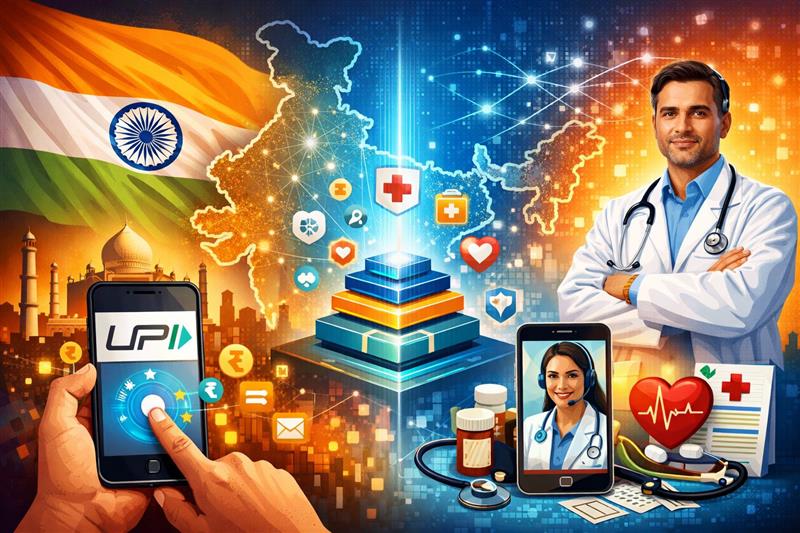
UPI transformed payments by placing individuals at the center, with financial institutions
participating around them. It succeeded where institution-centric initiatives failed. India's health
system needs the same architectural shift.
India has invested significantly in healthcare infrastructure—ABDM, UHI, digital health records,
hospitals, and IT systems. Yet chronic disease rises and costs escalate. Current systems are
institution-centered and episodic, while health is formed continuously in everyday life. What's
missing is a person-centered layer operating where health is actually lived.
What is PCU?
Personal Care Utility is a national-scale, person-centered health infrastructure operating
continuously in everyday life. PCU places individuals at the center, with healthcare providers,
public health programs, and institutions participating around them.
PCU provides three core functions: (1) trusted information in individual context, (2) seamless
interactions with doctors, and (3) continuous guidance in everyday life connected to clinical
care. It is infrastructure—not a disease program or app—enabling any health initiative.
PCU complements ABDM and existing systems. ABDM provides provider connectivity and
health records. PCU adds the person-centered layer—enabling continuous engagement
between clinical encounters, with seamless connection to providers when needed.
Why PCU Will Succeed
PCU's architecture ensures individual data ownership with federated learning—models improve
without centralizing sensitive information. It functions as public utility infrastructure, enabling
product companies to build applications that enrich and benefit from this foundation. Trust
comes through privacy-preserving design and data sovereignty, while federated architecture
works across diverse populations and existing systems.
Next Step: GIFT City Pilot
The Diabetes Project 2026 in GIFT City provides immediate proof-of-concept, establishing
partnership models (MEITY, Gujarat Government, healthcare providers) and validating
architecture. Success enables phased national rollout—diabetes first, then maternal health,
mental health, aging, and prevention.
India built person-centered infrastructure when others focused on institutions—that
vision created UPI's success. PCU represents the same opportunity for health: reducing
late-stage disease costs while building sovereign health AI capabilities. This is India's
chance to lead global transformation of health infrastructure.